


News
Published Date: 18 March 2026
Categories: Altcoin News,altcoin news,Altcoin News Today,
The long-awaited launch of the Aster chain finally arrived Yesterday, yet for ASTER crypto holders, the ongoing retracement this morning is less than jubilant, as ASTER price is currently trading at $0.71, trapped in a corrective move following a brief spike in speculative momentum following the mainnet launch. While the broader market stabilises, the asset faces a binary risk environment, and analysts are puzzling over whether the deployment of privacy-centric features will catalyse a breakout toward $3.4, or whether the “sell the news” phenomenon will dominate price action amid the ongoing retracement.
Crypto Mainnet Launch events are historically volatile, and ASTER is approaching this milestone with high expectations focused on its transition from a decentralized exchange (DEX) foundation to a full Layer-1 blockchain. Traders are closely monitoring the validation of specific roadmap deliverables, particularly formalized mandates for privacy and scalability. With the critical $0.81 resistance level holding and rejecting initial excitement, the market is deciding whether the network’s technical promises can sustain a valuation shift,.
ASTER Price Analysis: Resistance Levels and Momentum Setup
Technically, ASTER is oscillating within a tight channel, bounded by immediate support at $0.70 and overhead resistance at $0.81. The price action has formed a base over the last four weeks, characteristic of an accumulation phase often seen before major protocol upgrades.
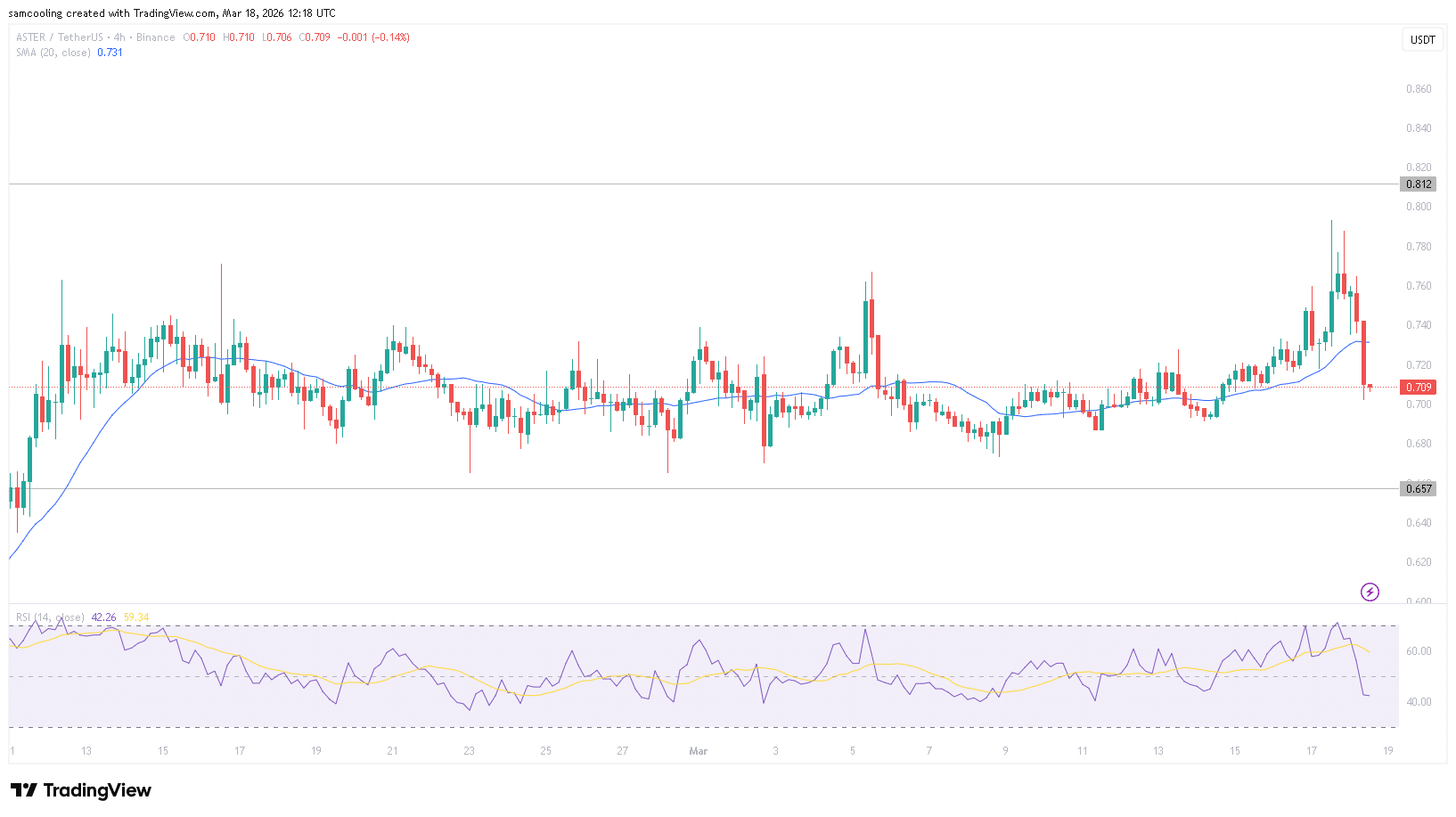
(Source – ASTERUSDT, TradingView)
Momentum indicators present a mixed but slightly bullish skew. The Relative Strength Index (RSI) on the daily chart is currently at 39.4, placing the asset in neutral-bullish territory with ample room to run before entering overbought territory.
The chart structure indicates that a decisive breakout above $0.81 is required to confirm a trend reversal. Until that level is reclaimed with significant volume, ASTER remains in a consolidation pattern, susceptible to broader market volatility.
DISCOVER: Hyperliquid Opens US Policy Advocacy Center
Stealth Addresses and Zero-Gas DeFi: What the Mainnet Upgrade Delivers
The core investment thesis for the ASTER rally hinges on two specific features: Stealth Addresses and Zero-gas DeFi. Unlike standard Layer-1 upgrades that focus primarily on throughput, this transition prioritizes privacy and friction reduction. Stealth addresses allow users to generate unique, one-time public keys for every transaction, effectively decoupling the recipient’s identity from their on-chain history. This feature addresses a growing demand for on-chain privacy following recent security concerns in the broader tech sector, where vulnerabilities often expose user data.
For context on why privacy features are becoming a primary narrative, recent industry reports have highlighted how easily standard protections can be bypassed. For instance, Google recently warned about exploits targeting mobile interfaces, underscoring the urgent market need for protocol-level privacy solutions like those proposed by Astar. If implemented successfully, these features could position the network as a preferred venue for high-value participants requiring anonymity.
Simultaneously, the introduction of Zero-gas DeFi aims to remove the unpredictability of transaction costs. By subsidizing specific interaction types, the network intends to onboard users who are typically priced out of high-frequency trading strategies on other chains. Analysts suggest that if these barriers are effectively lowered, the velocity of capital within the ecosystem could increase significantly post-launch.
Network Metrics: Does Ecosystem Activity Support a Rally?
On-chain data from the testnet phase offers a conflicting signal regarding readiness. Bullish metrics show that the public testnet attracted over 50,000 participants in early February, generating over $8 million in weekly platform fees. This revenue generation is pivotal, as the protocol’s roadmap includes a mechanism to funnel 80% of these daily fees into on-chain ASTER buybacks, theoretically creating constant demand pressure.
However, distinct caveats remain in the data. Despite the high number of participants, the number of monthly active addresses (MAA) retaining activity stood at only 340 by late February. This discrepancy suggests that while many users claimed airdrop eligibility or tested features, sustained engagement has not yet solidified.
Furthermore, developer activity—a leading indicator of future ecosystem value, needs to ramp up. The success of the Aster Network transition depends not just on users, but on builders deploying applications that leverage the new privacy architecture. Without a surge in unique dApp deployments in Q2, the fee-burn mechanism may lack the volume required to impact the token price.
DISCOVER: Ethereum Foundation Partners with Seal to Combat Wallet Drainers
Can ASTER Break $3.4? Two Scenarios Traders Are Watching
As the mainnet launch approaches, market participants are modeling two distinct outcomes for the ASTER price prediction.
The Bullish Scenario: If ASTER manages to close above the $0.81 resistance level on high volume, it confirms a breakout from the multi-week accumulation zone. In this scenario, improved liquidity and the activation of the fee-buyback mechanism could drive price discovery. Analysts identify $3.4 as the primary medium-term target, derived from Fibonacci extension levels and the anticipated market cap necessary to support the projected platform revenue. A roadmap including “Shield Mode” for private trading further bolsters this case, assuming the mainnet deployment occurs without technical glitches.
The Bearish Scenario: Conversely, failure to breach $0.81 would suggest that the mainnet launch is a “sell the news” event. If the price breaks down below the critical support at $0.70, the bullish structure is invalidated. In this outcome, traders could look for a retest of lower liquidity zones around $0.65. A lack of immediate adoption for the zero-gas features could exacerbate this sell-off, as speculative capital rotates into more established assets. Watch for volume spikes on the downside as a confirmation signal.
The post Aster Crypto Mainnet Launch Set for March: Can Privacy Features Drive $3.4? appeared first on Coinspeaker.