


News
Published Date: 17 March 2026
Categories: Bitcoin News,Bitcoin News Today,
Bitcoin (BTC) is trading near $73,900, consolidating below the psychological $75,000 threshold as the executive branch intensifies public pressure on the Federal Reserve. The catalyst is President Donald Trump’s demand for an immediate “special meeting” to slash interest rates, a political challenge to central bank independence that is forcing markets to reprice the probability of premature liquidity expansion ahead of the March FOMC.
While the Federal Reserve has maintained a restrictive stance to combat sticky inflation, the President’s insistence that cuts occur “right now” introduces volatility into risk assets. Markets are currently weighing the likelihood of the Fed capitulating to executive pressure against the backdrop of steady economic data, a dynamic that directly impacts the cost of capital and, by extension, the net liquidity available for speculative assets like crypto.
EXPLORE: Bitcoin and Stocks Stabilize as Bond Market Flashes Risk-Off Signals
Fed Independence and the Liquidity Equation
President Trump’s recent comments, delivered at a White House meeting and amplified on social media, explicitly target Fed Chair Jerome Powell’s data-dependent approach. Trump argued that a “third-grade student” would understand the need for cuts, framing the current 3.50% to 3.75% target range as a national security threat. For crypto markets, the mechanism of action here is the implied cost of leverage. Trump’s push for lower rates aims to reduce debt-service costs on the $39 trillion national debt, but it also signals a potential shift toward fiscal dominance, a scenario in which monetary policy is forced to accommodate government spending.
Despite the political rhetoric, the data does not yet support an immediate pivot. The CME FedWatch Tool currently indicates a 99% probability that rates will remain unchanged at this week’s FOMC meeting. The probability for the subsequent April 29 meeting is similar at 97% for a hold. This disconnect between the President’s demands and market pricing creates a binary risk environment: if the Fed holds firm as expected, liquidity remains tight; however, any dovish signal from Powell would likely be interpreted as a capitulation, triggering a rapid repricing of the dollar and a surge in risk assets.
The tension is further complicated by the fiscal landscape. With the proposed “One Big Beautiful Bill Act” projecting massive injections into the economy, inflation risks remain elevated at 2.4%. Bankrate economist Michael Nguyen notes that such injections typically spur GDP growth but simultaneously drive inflation higher. Should the Fed cut rates prematurely into this fiscal stimulus, real rates could turn deeply negative—a historically bullish condition for hard assets like Bitcoin.
EXPLORE: Arthur Hayes Analysis: Bitcoin and Nasdaq Divergence Amid Liquidity Stress
Cross-Asset Correlation: Bitcoin as a Liquidity Proxy
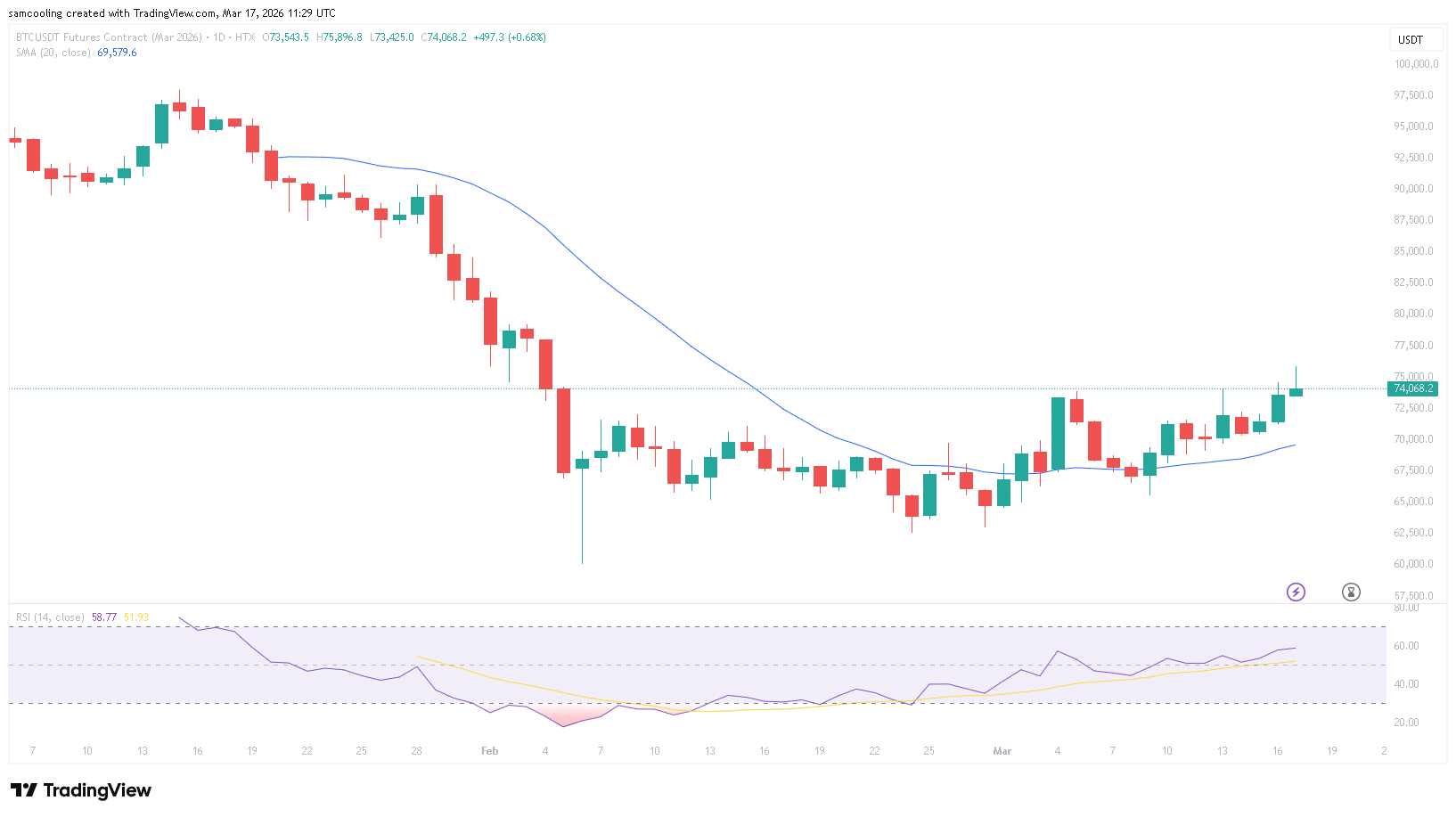
(Source – BTC USD, TradingView)
Bitcoin’s price action currently reflects its status as a high-beta proxy for global liquidity rather than a pure safe-haven asset. The 30-day correlation between BTC and the Nasdaq 100 remains tight, suggesting that crypto markets are trading primarily on the discount rate mechanism. If Trump’s pressure campaign succeeds in forcing yields lower, the resulting liquidity expansion would disproportionately benefit growth-sensitive assets.
However, a decoupling scenario exists. If the bond market interprets a potential rate cut as a policy error that will reignite inflation, the 10-year Treasury yield could spike in anticipation of long-term devaluation. In this environment, some analysts argue Bitcoin could diverge from equities, behaving more like digital gold amid sovereign debt concerns. Currently, however, the primary driver remains the immediate cost of money, with Bitcoin reacting sharply to any shifts in the federal funds futures curve.
To the upside, the critical resistance level remains $72,000. Reclaiming this level on spot volume would confirm a breakout from the current accumulation phase. Technical indicators suggest neutrality, with the RSI hovering near 50, indicating the market is waiting for a definitive macro trigger—likely the FOMC’s statement or dot plot update—to choose a direction.
EXPLORE: BTC USD Risks $70K Support Break as Oil Spikes Toward $120
March FOMC Institutional Flow Implications
Institutional flows appear to be pausing in anticipation of the Fed’s next move. While spot Bitcoin ETFs, including BlackRock’s IBIT and Fidelity’s FBTC, have seen consistent inflows year to date, the pace has decelerated as Treasury yields remain elevated. Institutional allocators are essentially earning a risk-free 3.5% to 4% in short-term government paper, raising the opportunity cost of holding non-yielding assets like Bitcoin.
Analytics firm Glassnode data indicates that long-term holder supply remains resilient, suggesting that conviction buyers are ignoring the short-term political noise. However, for a sustained move higher, the market requires net new capital inflows, which are historically correlated with periods of monetary easing. If the Fed signals that it will ignore executive pressure and maintain a “higher for longer” stance, we could see a temporary rotation of capital out of risk assets and back into fixed income.
Until the Federal Reserve clarifies its stance vis-à-vis the administration’s pressure, the probability of range-bound volatility remains elevated, effectively capping Bitcoin’s immediate upside near resistance levels.
The post Trump Pressures Fed for Rate Cuts: What It Means for Bitcoin and Crypto appeared first on Coinspeaker.